
ASC
ASC Supply Chain Mapping and Stock Status: Compliance Checklist for Farms
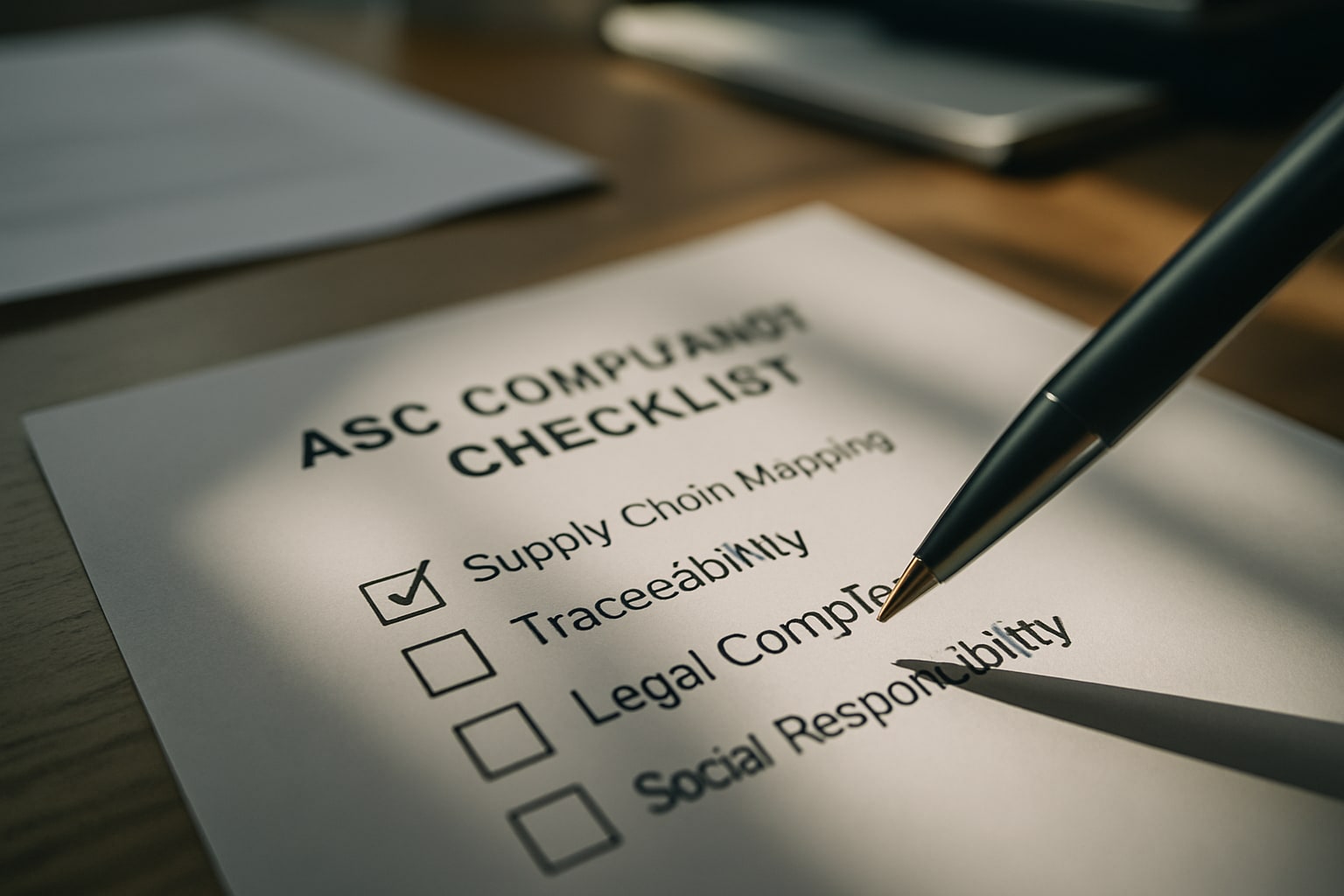
Supply Chain Mapping Requirements
Under Criterion 1.5 of the ASC Farm Standard, all farms seeking certification must establish transparent traceability throughout their supply chain. The first and foundational step is mapping the complete supply chain from broodstock onwards using the official ASC Supply Chain Mapping Template, which is provided on the ASC website.
According to the Interpretation Manual, traceability in the supply chain is essential for ensuring transparency, improving product quality and safety, and promptly identifying and addressing issues. The scope of the supply chain that must be mapped includes all sites supplying certifiable products, starting from broodstock.
Action Items: Supply Chain Mapping
- Obtain the ASC Supply Chain Mapping Template from the ASC website. This is the required format for documenting your supply chain.
- Identify all suppliers in your supply chain, beginning with broodstock sources and continuing through all intermediate production stages to your own site.
- Complete the template with comprehensive information about each supplier in the chain.
- Verify accuracy by cross-checking the completed mapping with your purchase records to ensure alignment.
- Maintain the completed template as evidence of implementation and make it available for audit review.
- Update the mapping whenever your supply chain changes—for example, if you switch suppliers or add new sources of stock.
Stock Status Record Requirements
Indicator 1.5.2 of the ASC Farm Standard mandates that farms only stock ASC certifiable product if accompanied by a completed ASC Stock Status Record. The Stock Status Record is a batch-specific document that holds critical information about products moving through the supply chain.
According to the Interpretation Manual, the ASC Stock Status Record holds batch-specific information on products moving through the supply chain, including information on:
- Origin of broodstock
- Treatments applied
- Feed used
- ASC certification status
Action Items: Stock Status Records
- Obtain the ASC Stock Status Record template from the ASC website for each batch of stock you receive.
- Require suppliers to complete and provide the Stock Status Record before accepting any deliveries of ASC certifiable product.
- Verify completion of all mandatory fields in the Stock Status Record upon receipt.
- Cross-reference information in the Stock Status Record with your purchase orders and delivery documentation to ensure consistency.
- Store Stock Status Records securely and organize them by batch, delivery date, and supplier for easy retrieval during audits.
- Maintain records electronically with backup systems, or in secure physical storage if using paper records, to prevent loss or damage.
- Link Stock Status Records to your traceability system so that batch information can be quickly accessed and traced.
Supply Chain Conformance Documentation (Species-Specific)
Indicator 1.5.3 establishes additional requirements for farms producing freshwater trout, flatfish, seabass, seabream, meagre, and salmon. For these species, farms must demonstrate that all sites in the supply chain conform with the requirements listed in Appendix 14 of the ASC Farm Standard.
An exemption applies for broodstock sites and for farms holding valid ASC certification. Additionally, an exception applies for salmon sites supplied with product from other cage site(s), in which case all cage site(s) in the supply chain must be ASC certified.
Action Items: Supply Chain Conformance (Species-Specific)
- Determine if your farm produces freshwater trout, flatfish, seabass, seabream, meagre, or salmon—if not, Indicator 1.5.3 does not apply.
- Identify all supplier sites in your supply chain that are not exempt (i.e., not broodstock sites or ASC-certified sites).
- Gather documentation from each non-exempt supplier demonstrating conformance with Appendix 14 requirements.
- Review Appendix 14 (section 14.1) in the ASC Farm Standard to understand the specific conformance criteria that suppliers must meet.
- Maintain documentation to the extent necessary to ensure suppliers conform with Appendix 14 requirements.
- For salmon farms specifically: If your site is supplied by other cage site(s), confirm that all cage site(s) in the supply chain hold valid ASC certification.
- Store supplier conformance documentation with your supply chain records and produce it during audits as evidence of due diligence.
Audit Preparation and Record Management
Auditors will verify that the ASC Supply Chain Mapping Template is completed, listing the supply chain from broodstock onwards, and will cross-check this mapping with purchase records. They will also confirm that the ASC Stock Status Record is completed for all relevant batches.
To prepare for audit, ensure that:
- All templates and records are current and accessible in one location.
- Your supply chain documentation clearly shows the origin and path of all stocked animals.
- Batch information in Stock Status Records aligns with your production records and traceability system.
- For applicable species, supplier conformance documentation is complete and organized.
- Records are legible, dated, and, where appropriate, authorized or verified by a supervisor.
This article summarises ASC-INT-001-ASC-Farm-Standard-Interpretation-Manual-V1.0.1-September-2025.pdf. Refer to the original document for the authoritative text and full requirements.